


| The facts on student reading proficiency |
| Take a look, it’s in a book — but how much are kids reading anymore? For that, let’s turn to the National Assessment of Educational Progress (NAEP), which measures students’ reading progress every two to four years. Here’s a read on national reading proficiency rates, plus how they’ve shifted over time. A note on terminology: the NAEP uses “proficient” to describe students who demonstrate competency with challenging subject matter. This is one of three achievement levels, with “advanced” being above proficient, and “basic” being below. But “proficient” isn’t the same as “grade level,” which is often measured by state and district tests. Okay, let’s dive in. About 31% of 4th graders, 30% of 8th graders, and 35% of 12th graders were considered proficient or advanced in reading in 2024. |
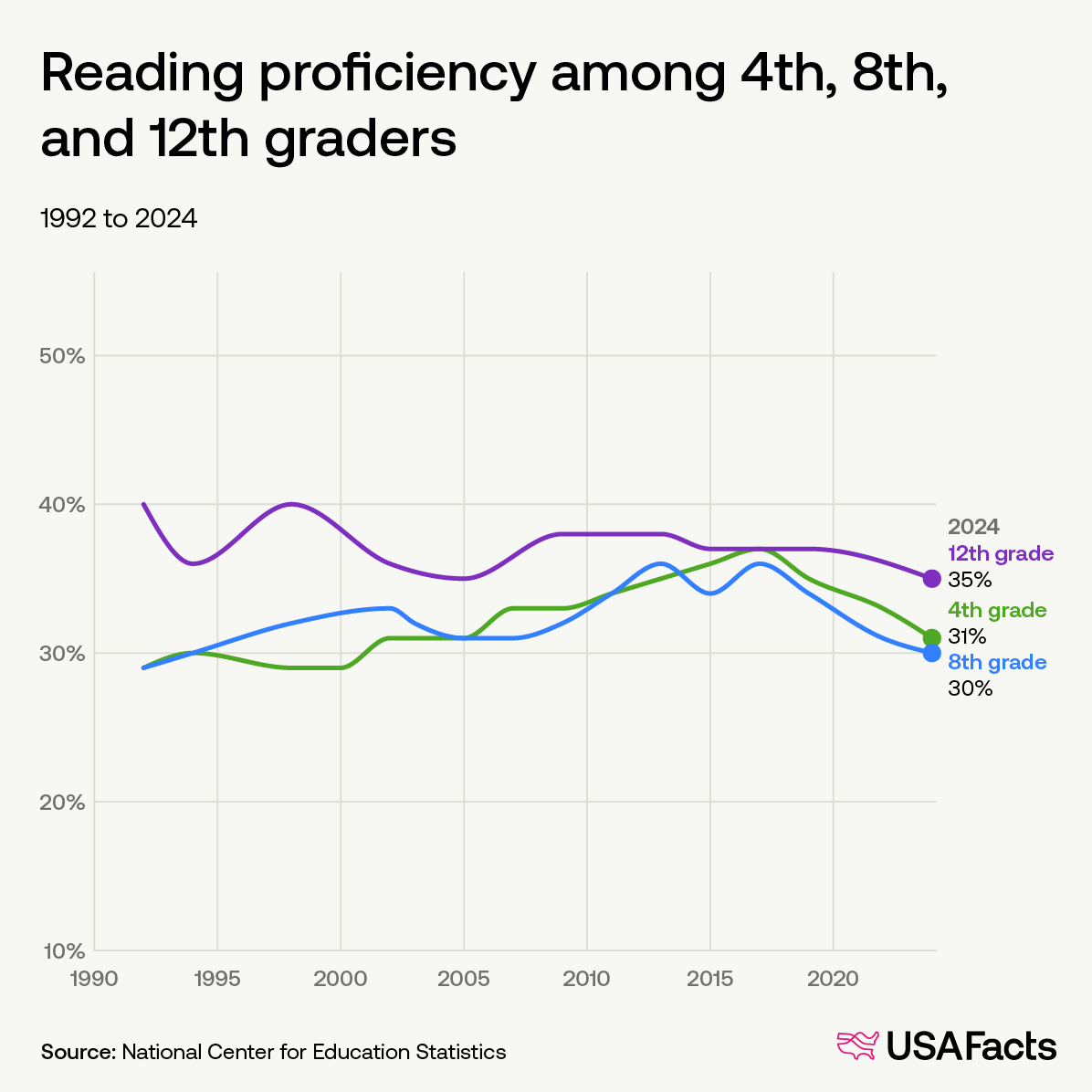
| For grades 4 and 8, around 69% and 70%, respectively, scored at basic or below basic reading levels. Students in 12th grade fared slightly better, with 65% at basic or below. Fourth graders had lower reading proficiency in 2024 compared to 2022. Twelfth graders also had lower reading proficiency in 2024 compared to 2019. In just over three decades of data, fourth graders’ reading proficiency was highest in 2017 (37%). It was highest for 8th graders in 2013 and 2017 (36%), and highest for 12th graders in 1992 and 1998 (40%). When looking at differences by gender, female students in 4th grade have had reading proficiency rates of 4 to 9 percentage points higher than male students in every test year since 1992. |