

A ‘Super’ El Niño Is Here. Can the US Power Grid Handle It This Winter?
El Niño tilts the odds toward anomalous weather that can impact the U.S. power system in both good ways and bad ways.
By Ellyn Lapointe Published October 10, 2026, 6:00 am ET
Reading time 5 minutes
Read Later
Power Shift is Ellyn Lapointe’s ongoing Gizmodo series that explores advancements in green technology, with a focus on renewable energy, grid modernization, and emissions reduction.
When signs that a strong El Niño was brewing first appeared in late spring, no one could have imagined just how powerful it would become.
Over the last several months, tropical Pacific sea surface temperatures have risen so fast that they’ve already surged past the record-warm peak of the very strong 2015-2016 El Niño. And they’re still climbing. Forecasts suggest this year’s El Niño won’t peak until December, and by that point, sea surface temperatures will likely have risen about 7.2 degrees Fahrenheit (4 degrees Celsius) above average.
El Niño alters weather patterns across the globe, and weather impacts every aspect of our lives, including the power sector. Its effects are often most pronounced during Northern Hemisphere winter, when Americans rely heavily on the grid for heating and lighting. So what could this exceptionally strong El Niño mean for the grid this winter?
The short answer to that question is: It’s complicated. El Niño-driven weather phenomena can damage power infrastructure and affect energy supply and demand, but its effects vary across the United States. Even strong El Niños like this one don’t guarantee specific weather outcomes. Regional differences in grid infrastructure and energy resources will also shape how vulnerable various parts of the country are to El Niño’s impacts.
With that said, stronger El Niños tend to tilt the odds in favor of expected weather outcomes, so experts can make some highly educated guesses about how this winter could unfold, how the power sector might respond, and what that would mean for American households.
How El Niño could impact US weather
El Niño is the warm phase of the El Niño-Southern Oscillation, the biggest source of year-to-year climate variation on the planet. This warm phase begins with a weakening of trade winds that pushes warm water from the western Pacific Ocean to the central and eastern tropical Pacific. When water temperatures off the coast of South America rise, the warming pumps huge amounts of heat and moisture into the atmosphere, altering weather patterns across the globe.
In the U.S., El Niño has historically increased the odds of a warmer, drier winter in the northern tier and a cooler, wetter winter in the southern tier and on the West Coast. That’s largely because El Niño causes the jet stream to shift southward and extend eastward across the South. But again, El Niño does not guarantee that specific weather events—such as ice storms or unseasonably warm days—will occur or be more severe.
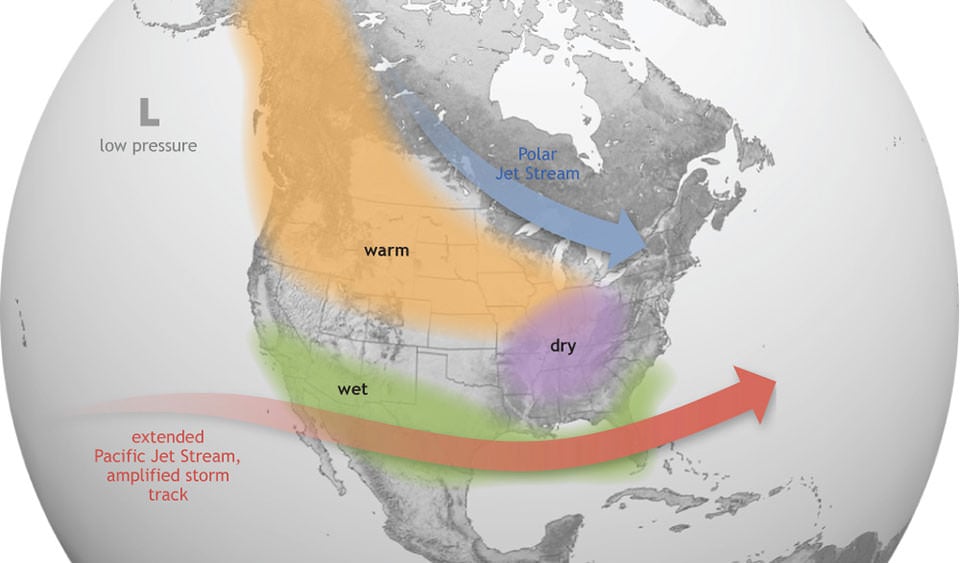
“When we see an El Niño, particularly a strong El Niño, what that tells us is there is a much higher likelihood of this or that. It’s not going to increase the magnitude of events,” Erik Smith, a technical lead for climate data analytics at the Electric Power Research Institute (EPRI), told Gizmodo.
Every El Niño unfolds differently, but forecasters gain a lot of predictive power by examining past events that look similar to what’s developing now, Smith explained. This year’s event is both very strong and somewhat eastern-shifted, like the 1997-1998 El Niño.
That event contributed to the second-warmest and seventh-wettest winter since 1895 for the contiguous United States. As expected, the southern tier saw wetter-than-normal conditions, while the northern tier saw warmer-than-usual conditions. Extreme weather events included flooding in the Southeast and California, an ice storm in the Northeast, and tornadoes in Florida.
It’s highly unlikely that this year’s El Niño will lead to exactly the same outcomes, especially because this event is shaping up to be even stronger. But looking at analogs in the climate record does provide some insight.
El Niño can impact energy supply and demand
Weather affects the power sector by influencing both energy supply and demand. In winter, colder temperatures typically increase demand as people use more energy to heat their homes. Because El Niño tends to favor warmer winters across the northern U.S., heating demand there may be lower than usual. In the South, where El Niño increases the odds of a colder winter, demand for heating could rise.
Because heating systems vary by region, El Niño’s effects on electricity demand do, too, Smith said. For example, most homes in the Midwest rely on natural gas for heating, while electric heating is more common in the South. A milder winter in the North could therefore reduce heating fuel demand more than electricity use, while a colder winter in the South could drive up electricity demand.
Historically, El Niño winters reduce heating degree days (a measure of how much heating is needed) in regions where heating demand is greatest, such as the Upper Midwest and Northeast. Because the South generally has lower heating needs to begin with, any increase in heating demand there tends to be smaller by comparison. Thus, national heating demand tends to be lower in an El Niño year even when the South is cooler than normal.
“That’s great for the system—less stress in the winter,” Michael Craig, an associate professor of energy systems at the University of Michigan, told Gizmodo. “That’s also great for household energy bills. Lots of energy-burdened households exist in the United States that spend a large portion of their monthly income on energy, so warmer temperatures will hopefully defray some of those burdens for those households.”
On the supply side, El Niño winters can reduce snowpack and reservoir storage in the Pacific Northwest, which generates about half of U.S. hydropower. While that can have a significant regional impact, hydropower only makes up 5.7% of the nation’s total energy mix.
Potential risks to physical grid infrastructure
Because El Niño tends to shift storm tracks toward the South and the West Coast, energy infrastructure in these regions may be more susceptible to damage this winter—particularly transmission and distribution lines.
High winds can uproot poles, snap cables, and send tree limbs or debris crashing into critical components. Heavy rain can cause flooding that submerges or corrodes structures. In California, rain-triggered mudslides are a particular concern, as these events can topple and destroy utility poles, transmission towers, and even sever underground lines. And in the South, ice storms can cause extensive power line failures.
“The more extreme weather events that you have—the higher wind speeds, the more lightning with risk for physical damage to infrastructure, to trees that can fall on lines—the more damage you’d expect to see,” Craig said.
Whether this strong El Niño actually leads to more extreme weather in the South and on the West Coast this winter remains to be seen, but utilities can look at past events to predict where certain risks are most likely to increase. They also perform seasonal forecasts to anticipate fluctuations in demand.
“I’m sure utilities have been working very hard to forecast what those effects would be and deal with it the best they can,” Craig said.
For example, if a utility expects a colder-than-average winter, it might increase natural gas or heating fuel storage to make sure it has enough supply on hand for generators, he explained. How the U.S. power grid fares this winter will depend not just on the impacts of this El Niño but on how ready the country’s energy systems are to handle what comes their way.

